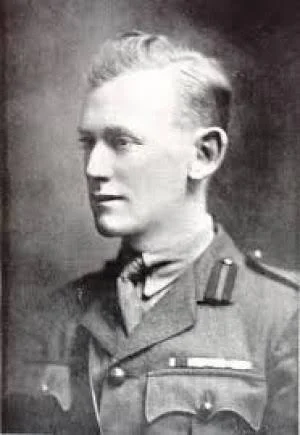
Joseph Edward Lee
From Duntroon to Gallipoli
As a member of H Company, 13th Battalion, Lieutenant Lee departed Australia aboard HMAT Ulysses A38 on December 22, 1914. On April 12, 1915, he proceeded to the Mediterranean Expeditionary Force at Gallipoli.
The Mediterranean Expeditionary Force was the British Army formation initially led by General Sir Ian Hamilton, commanding Allied land forces during the Gallipoli Campaign.
Lee’s service records place him at Anzac Cove on the Gallipoli Peninsula from April 26 to August 7, 1915. On July 19, he was temporarily promoted to captain after another captain was wounded.
Official war correspondent Charles Bean later recorded Lee’s involvement with the 13th Battalion as it moved up the Aghyl Dere during the Battle of Sari Bair on August 7, 1915.
As the Australians advanced towards Aghyl Dere, a local guide took them along a shorter route than the one reconnoitred by Major Overton, between Walden Point and Bauchop’s Hill.
Lee was with the platoon advancing on the right, moving up the slope when they came under fire from a fold in the Aghyl Dere. The men were ordered not to fire unless instructed by their officers, and they continued advancing in silence as the Turkish forces retreated.
About 100 yards further on, a group of Turkish soldiers opened sustained rifle fire. Lee ordered his men to fire five rounds at a distance of 30 yards before charging the enemy position.
During the fighting, Lee was wounded by bullets to the back of his left arm, behind the radial surface artery, and to his thigh. The Turkish forces retreated before the Australians reached them.
Lee was transferred to the hospital ship Delta on August 7 and arrived at Ghezirah on August 12, before being admitted to No. 2 General Hospital.
On September 15, he embarked aboard the hospital ship Asturias at Alexandria, bound for England. He disembarked at Southampton on September 26 and was admitted to the 3rd London General Hospital that same day.
He was discharged from hospital and granted sick leave on October 1. On December 6, 1915, he was admitted to No. 5 Australian Auxiliary Hospital, although no discharge date was recorded.
Military Cross and service in France
Lee returned to Egypt for duty on February 22, 1916. He was mentioned in despatches on February 29.
At Tel el Kebir on March 1, 1916, Lee was promoted to captain to fill a vacant position. On March 12, he was appointed adjutant, serving as the battalion commander’s right-hand man, and transferred from the 13th Battalion to the 45th Infantry Battalion.
On April 13, 1916, Base Records sent his father a letter informing him of the award of the Military Cross.
The letter stated:
“His Majesty the King has been graciously pleased to approve of the undermentioned award for distinguished service in the Field, with effect from 1st January 1916, inclusive: — AWARDED THE MILITARY CROSS. Lieutenant Joseph Edward Lee, 13th Battalion.”
The letter was posted to Narraport via Birchip.
On June 2, 1916, Lee embarked aboard the transport Kinfauns Castle at Alexandria to join the British Expeditionary Force. He disembarked at Marseille the following day.
The 45th Battalion was involved in the fighting at Pozières during August 1916. On August 6, Lee was promoted to major in the field following the death of Major D. K. Chapman, who had been killed in action.
The day brought heavy casualties as continuous German bombardment destroyed the captured trenches occupied by Australian troops. The battalion earned a reputation at Pozières for carrying out its duties regardless of the consequences.
Lee continued as adjutant of the 45th Battalion until September 1916.
On November 14, he was admitted to hospital from the battalion in the field. The following day, after passing through the 38th Casualty Clearing Station, he was admitted to the 8th General Hospital at Rouen with pyrexia, or fever.
He was discharged from hospital on November 24 and marched in on November 27. After leaving the Reinforcement Camp at Étaples on December 3, he rejoined his battalion in the field the following day.
Leadership on the Western Front
On January 5, 1917, Lee was seconded for training as staff captain at 12th Brigade Headquarters. On April 2, he was detached for training at Staff School in England.
The course ended on May 22, and Lee proceeded overseas from London, rejoining his unit in the field on June 2.
As brigade major, Lee accompanied General Holmes to the front line at dawn on June 10, 1917, to assess the situation. They moved towards a barricade erected by the 45th Battalion and observed the nearest German blockhouse, which was only 40 yards away.
It was decided that the area would be bombarded during the day, with an attack to begin immediately after dark. The 45th Battalion would bomb its way forward to meet the 50th Battalion.
On July 27, Lee was attached to 1st Anzac Headquarters as a brigade major trainee, having been transferred from 12th Infantry Brigade Headquarters.
On August 7, he ceased his secondment as brigade major trainee at 1st Anzac Corps Headquarters and was seconded for duty as brigade major at 7th Brigade Headquarters.
However, on August 22, Lee was admitted to the 7th Field Ambulance in France after accidentally fracturing his left clavicle while on ordinary duty at Divisional Bombing School. He was subsequently transferred to the 7th General Hospital at St Omer.
On August 24, he relinquished his appointment as brigade major because he was being invalided. He was transferred to No. 3 General Hospital at Le Tréport on August 30.
Lee was discharged from hospital and rejoined 7th Brigade Headquarters on October 4, 1917. On October 12, he was appointed brigade major of the 7th Infantry Brigade.
Distinguished Service Order
On September 20, 1918, Lee was recommended for the Distinguished Service Order (DSO) in recognition of his leadership and dedication.
The recommendation, submitted by Major-General Charles Rosenthal, commanding the 2nd Australian Division, praised Lee’s work with the 7th Australian Infantry Brigade Headquarters.
It stated that Lee had demonstrated “great devotion to duty during the whole of the period this Officer has been with the Brigade, namely about 12 months”.
The recommendation continued:
“His work in and out of action has been conspicuously good, and very valuable. During the most strenuous periods when active operations were in progress, he would never rest or go off duty, although often physically exhausted.”
It also praised his sound advice, tactical knowledge and daring reconnaissance work, which were described as invaluable to the brigade.
Lee was awarded the Distinguished Service Order for his service, adding to the Military Cross he had received earlier in the war.
Return to Australia
On February 4, 1919, Lee ceased his attachment to the War Office and was posted for duty with the Repatriation and Demobilisation Department.
He was subsequently detached from that duty and proceeded to the Deputy Assistant Adjutant General for disposal on February 26.
On March 9, 1919, Lee embarked aboard HT Kashmir for Australia, arriving on April 30. His appointment with the Australian Imperial Force was terminated in Melbourne on June 29, 1919.
Later life and legacy
Electoral rolls show Lee living at 170 Phillip Street in King, West Sydney, in 1954, with no occupation recorded. By the 1958 electoral roll, he was living at the Royal Hotel on Perouse Road, Randwick.
Joseph Edward Lee died in Randwick on August 11, 1962. His death was reported in The Sydney Morning Herald on August 13.
Lee was the 56th person to enter the Royal Military College Duntroon. His military decorations and service medals included the Distinguished Service Order, Military Cross, 1914–15 Star, British War Medal, Victory Medal with Oak Leaf, 1939–45 War Medal, Australian Service Medal and 1937 Coronation Medal.
Born in the farming district near Birchip, Lee went on to become a decorated officer whose service spanned Gallipoli and the Western Front, leaving a significant record of military leadership and dedication.
Veteran’s Voices: Birchip Brigadier Joseph Edward Lee
Originally published by Wimmera Mallee News. Contributed by Sally Bertram.
Joseph Edward Lee was born in Narraport, near Birchip, on December 10, 1893. One of seven children born to John Thomas Lee and Margaret Barber, he would go on to build a distinguished military career, serving in some of the most significant battles of the First World War.
Lee entered the Royal Military College Duntroon in Canberra on March 7, 1912, becoming part of the second class to graduate from the institution since its establishment.
On March 12, 1913, Canberra was officially founded and named by Lady Denman as Australia’s capital, resolving the rivalry between Sydney and Melbourne. The foundation ceremony marked the first occasion cadets from Duntroon paraded outside the college grounds.
Among them was Joseph Lee, who was particularly interested in seeing Lady Denman because she was a distant cousin of his.
Lee graduated from Duntroon on November 2, 1914, and was appointed a first lieutenant.
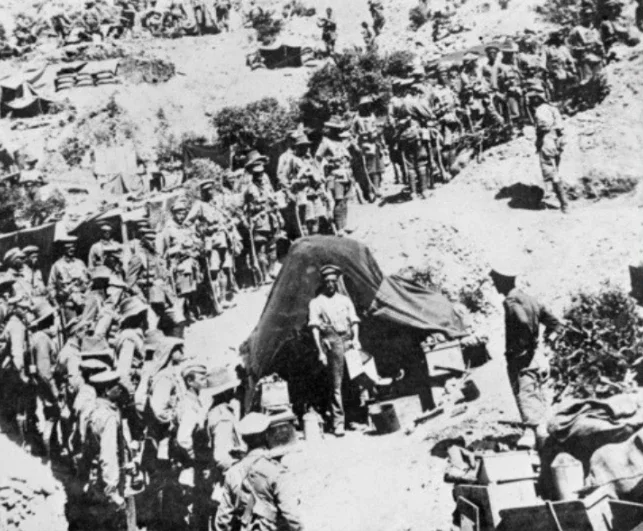
Left image: A platoon of the 13th Battalion formed on a steep path waiting for Captain Joseph Lee to address them. The men are in full battle order and it is probably prior to thier advance on Sari Bair. Captain Lee is standing in front of the tent. Sphinx Gully, Gallipoli, August 7, 1915.