
Robert Arthur Kemp
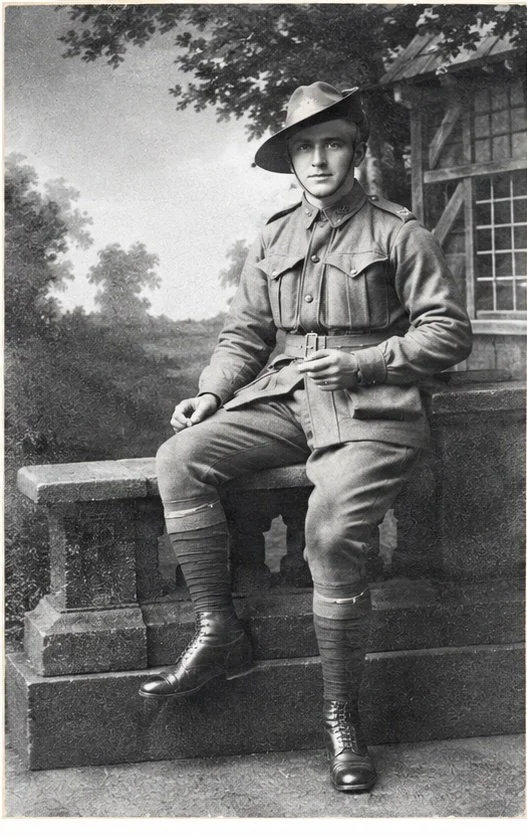
Their first stop in France was Etaples, a large army camp on the south coast, where they received equipment and final instructions before proceeding to the front as reinforcements. Robert saw plenty of action until April 1918, when he suffered a severe attack of tonsillitis that required several weeks in hospital.
However, he was back in the thick of the fighting before long.
During the summer of 1918, the newly invented British tanks were used to help destroy German machine-gun positions that were causing considerable damage to the infantry around Foucaucourt. As part of General Rawlinson’s plan to drive the enemy back from a plateau south of the Somme, the First Division was to be assisted by a dozen Mark V tanks. However, because these vehicles were scarce and valuable, they were ordered to return once their task was completed rather than roam the battlefields.
The attack on 23 August was later described as “one of the hardest blows ever struck against the Germans by Australian troops”. It was on this memorable day that Private Robert Arthur Kemp was awarded the Distinguished Conduct Medal (DCM).
The medal was awarded for conspicuous gallantry at Herleville Wood, near Foucaucourt, on 23 August 1918. Robert had volunteered to work in a tank during the attack. Owing to a heavy smoke barrage, the tank lost its direction, crossed a sunken road and crashed into a large tree, stopping only a few yards from the entrance to a German dugout.
The tank immediately burst into flames. Its occupants, half-dazed and suffocated by smoke, scrambled out, only to face point-blank machine-gun fire from the enemy dugout. The tank crew members were badly disoriented, and three were severely wounded.
Realising the danger they were in, Robert led the party forward despite the heavy enemy machine-gun fire. After a brief hand-to-hand struggle, he captured the position, killed many of the enemy, and rescued the three wounded tank crew members who had been taken prisoner. He then brought them safely back to the rear.
Robert was promoted to lance corporal. Following his injury, he was sent to Ipswich Hospital, where he fell in love with his nurse, Margaret Beatrice Moore. He persuaded her to come to Australia and marry him once he had a home ready for her.
Robert visited his home in Suffolk and was reunited with his parents, who were proud of him. He was repatriated and left for Australia on 7 September 1919, sailing on the same boat that had taken him to the war almost four years earlier.
After Robert and Arthur returned to Victoria, they both applied for soldier-settlement blocks in the Malmsbury district, where they had previously worked. They were told they had a better chance of obtaining land if they applied in the north-western region of the state, so they caught a train to Mildura.
Unfortunately, a severe dust storm was raging through northern Victoria that day, and they thought Mildura looked most unattractive. They therefore climbed back aboard the train heading for Melbourne.
Coincidence, or a chance meeting, can prove to be an invisible force in one’s life. When Robert and Arthur alighted from the train at Birchip to buy refreshments, they suddenly saw a familiar face in the crowd. It was Reverend Porter, a former minister of the Malmsbury Anglican Church, where the two young men had worshipped.
The priest was happy to see them and naturally wanted to hear about their wartime experiences. He suggested they stay overnight with him in Birchip, after which he would help them find work on the wheat farms in the district.
Reverend Porter introduced them to Mr R. J. Barber, the original owner of the house that later became Birchip’s Bush Nursing Hospital. Barber was willing to employ them on his wheat and sheep property.
Robert and Arthur worked hard and eventually saved enough money to purchase a block of land in the Parish of Carapugna. Some time later, they were each offered a block of land under the Soldier Settlement Act. They sold the land they had jointly owned to obtain the money needed to build houses on their respective blocks.
Robert’s fiancée, Nurse Margaret Moore, was among the last of the many English war brides to arrive in Australia. She travelled aboard the Demosthenes, which sailed from England on 10 April 1923. Robert met her at Port Melbourne, and they were married at St Paul’s Cathedral before he took her to live in the bush.
Margaret came from Norwich, an ancient city dating back to the time of the Roman occupation. She loved Robert and was willing to embrace a new life, a new culture and an unfamiliar climate. She also helped her husband transform their piece of bushland into a productive farm.
Robert was not only a hard-working farmer but also a community-minded man. He served on the Wycheproof Shire Council, which was a voluntary commitment in those days.
Over the years, Robert and Margaret purchased more land in the Parish of Karyrie to add to their original block. They had four children, Kenneth, Norman, Pauline and Gerald, all of whom were born in Birchip.
During the Second World War, their eldest son, Kenneth Kemp, joined the Royal Australian Air Force (RAAF). After completing his training in Australia, he sailed for Great Britain, where he joined No. 77 Squadron of the Royal Air Force at Full Sutton, near Stamford Bridge in East Yorkshire.
As an air gunner, Kenneth flew 33 missions over Europe. During one mission, his plane was hit by anti-aircraft guns, forcing him to bail out over Belgium behind enemy lines. All members of the crew managed to escape capture and were helped by resistance fighters to return to England.
The six crew members received decorations for their courage. Three were awarded the Distinguished Flying Cross (DFC), while the other three received the Distinguished Flying Medal (DFM).
Robert Arthur Kemp married twice more after his English war bride, Margaret Beatrice Moore, died in 1954.
Arthur Coe and His English War Bride
Arthur Coe share-farmed with Robert Kemp for several years. He also had an English war bride, Millie, who came to Australia in August 1921.
Millicent Sarah Barrett was a nurse who had served throughout the war in the Queen Mary’s Army Auxiliary Corps (QMAAC). She attained the rank of “Forewoman”, which the original account describes as equivalent to a matron in a civilian hospital.
For her devotion to duty, Millicent was awarded the MBE, the Most Excellent Order of the British Empire. The award included an invitation to an afternoon party in the garden of Buckingham Palace on Friday, 25 July 1919, from 4 pm to 6.30 pm, weather permitting.
A son, Wanswell George Coe, was born to Arthur and Millie on 17 February 1923. He was baptised at the Karyrie church by Reverend A. J. Porter, the same clergyman who had persuaded Robert Kemp and Arthur Coe to stay in Birchip.
In 1937, Arthur Coe and his war bride returned to England and settled there. Most war brides remained in Australia because they could not afford the cost of travelling back to their home country. Millie was therefore one of the fortunate few whose husband was able to take her home when she became homesick.
Two English Brides
Although Robert Arthur Kemp was born in Suffolk, England, he enlisted in Melbourne with the Australian Imperial Force (AIF) on 21 February 1916, at the age of 21. He had left his home as a young man to seek his fortune in Australia, where he knew he would find plenty of work as a farmhand.
Robert’s parents owned Walnut Tree Farm in the village of Thorington, near the small town of Saxmundham in north-east Suffolk. He had spent his youth in the beautiful English countryside, assisting his father on the farm.
Robert came to Australia with his friend, Arthur Coe, and they travelled on the steamer Makarim, which arrived in Melbourne on 14 June 1914. Arthur Coe claimed he was the wealthier of the two because he had 30 shillings in his pocket when they arrived.
They were working on land south of Kyneton when war began, and Arthur Coe joined the AIF at the same time as Robert. Enlistment papers show Robert Kemp’s height as six feet, making him one of the tallest soldiers in the 6th Battalion.
Private Kemp embarked from Melbourne on 11 September 1916 aboard the troopship Euripides, which reached Plymouth on 26 October after a six-week voyage. From this major seaport in the west of England, soldiers were put on trains and taken to the large camps on Salisbury Plain, where Australians completed their training before going overseas.